Compare densitometers, colorimeters, spectrophotometers, and spectroradiometers in the context of real calibration and proofing workflows.
How color is measured
For a long time, color evaluation in the graphics chain depended heavily on experience and visual judgment. Modern production, however, needs measurable and repeatable data. Color measurement instruments make communication clearer, help align devices, and reduce ambiguity between capture, proofing, and print.
In practice, four main categories of instruments are used: densitometers, colorimeters, spectrocolorimeters, and spectrophotometers. Spectroradiometers are also used when the subject of measurement is a light source rather than a reflective sample.
Densitometers
A densitometer measures how much light is absorbed or reflected by a material. In print and photographic workflows, it has long been used to control film density, ink density, and tone behavior.
A densitometer expresses results on a logarithmic scale and is invaluable for process control, but it does not describe color in a full colorimetric sense. It tells us about density, not about the complete appearance of a color.
Colorimeters
General principles
A colorimeter is built to approximate the response of human vision through filtered sensors. It provides values derived from standardized tristimulus behavior and is therefore much closer to colorimetric evaluation than a densitometer.
Because it uses a model of visual response rather than subjective observation, it can reveal differences too small to be seen reliably by eye alone.
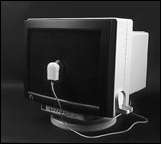
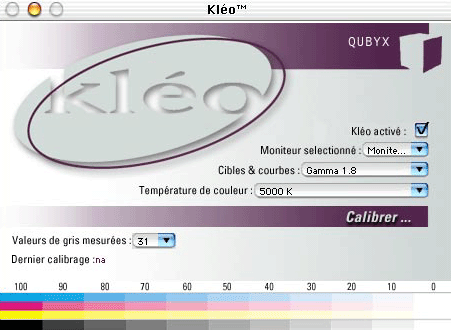
Colorimeters are particularly useful for monitor calibration and display profiling, where repeatable measurement of white point, luminance, and gamma behavior is essential.
How a colorimeter works
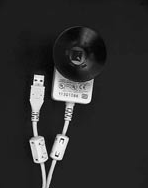
A colorimeter typically combines a sensor, a filter set, and onboard processing. The filters are chosen to approximate the visual response of the eye, allowing the instrument to convert measured light into standardized color values.
Spectrocolorimeters
Spectrocolorimeters extend the principle of the colorimeter by using more detectors and by measuring spectral behavior in greater detail. The device then computes tristimulus values from the measured reflectance data.
Spectrophotometers
General principles
A spectrophotometer measures reflected or transmitted light across wavelength intervals, usually throughout the visible spectrum. Because it captures spectral information rather than only filtered response, it can evaluate color with a much higher degree of flexibility and precision.
This makes the spectrophotometer especially valuable when metamerism, illuminant changes, or detailed material characterization must be considered.
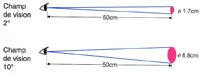
Observer angle: 2° and 10°
Many instruments allow measurements based on either the 2° or 10° standard observer. These settings exist because the eye’s color sensitivity changes depending on the field of view and the angular size of the observed area.
At a reading distance of about 50 cm, a 2° field corresponds to a much smaller viewed area than a 10° field, so the choice matters when comparing results.
How a spectrophotometer works
Unlike a colorimeter, a spectrophotometer relies on a dispersive optical system such as diffraction gratings or interference filtering. It breaks incoming light into narrow wavelength bands and reconstructs the sample’s spectral curve from those measurements.
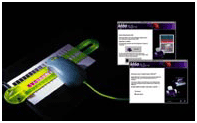
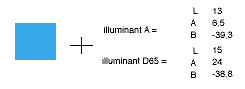
Spectrophotometers used in print and proofing often support a wide set of illuminants such as A, C, D50, D55, D65, and D75. That flexibility makes them central tools in profiling, proof verification, and substrate evaluation.
Spectroradiometers
A spectroradiometer measures the spectral distribution of a light source directly. It is used for high-end display work, lighting analysis, and research, though its cost generally places it outside routine production use.
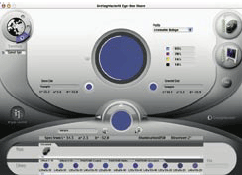
Choosing the right instrument depends on the task. Densitometers are ideal for density control, colorimeters for display work and fast color checks, spectrophotometers for full device characterization, and spectroradiometers for light-source analysis.