Prove your display is production-ready with professional monitor calibration verification. Generate certified reports, Delta E charts, and compliance documentation accepted by broadcast, print, and post-production standards bodies.
Calibration is only trustworthy when it is verified. PerfectChroma measures post-calibration accuracy, records the evidence, and turns it into reports you can actually hand to clients or compliance teams. Studios, broadcasters, and print facilities demand verifiable proof that your display meets ICC, EBU, or SMPTE grading standards. "I calibrated it" is no longer sufficient. You need a paper trail of monitor calibration verification.
Without timestamped measurement logs, there is no way to prove your display was within tolerance when a critical deliverable was approved.
Netflix, Disney+, and major broadcast networks require documented proof of display calibration for approved post-production facilities. Without it, you're disqualified.
Color accuracy is only as good as the measurement that proves it. Without Delta E99 or Delta E2000 data, you can't quantify or communicate your display's accuracy to clients or QC supervisors.
Export proof that your monitor was within tolerance at the time of approval, complete with ΔE data, target information, and a repeatable audit trail. PerfectChroma runs a full post-calibration pass - measuring 100+ test patches, computing Delta E error maps, and packaging the monitor calibration verification data into a professional PDF report with your studio branding.
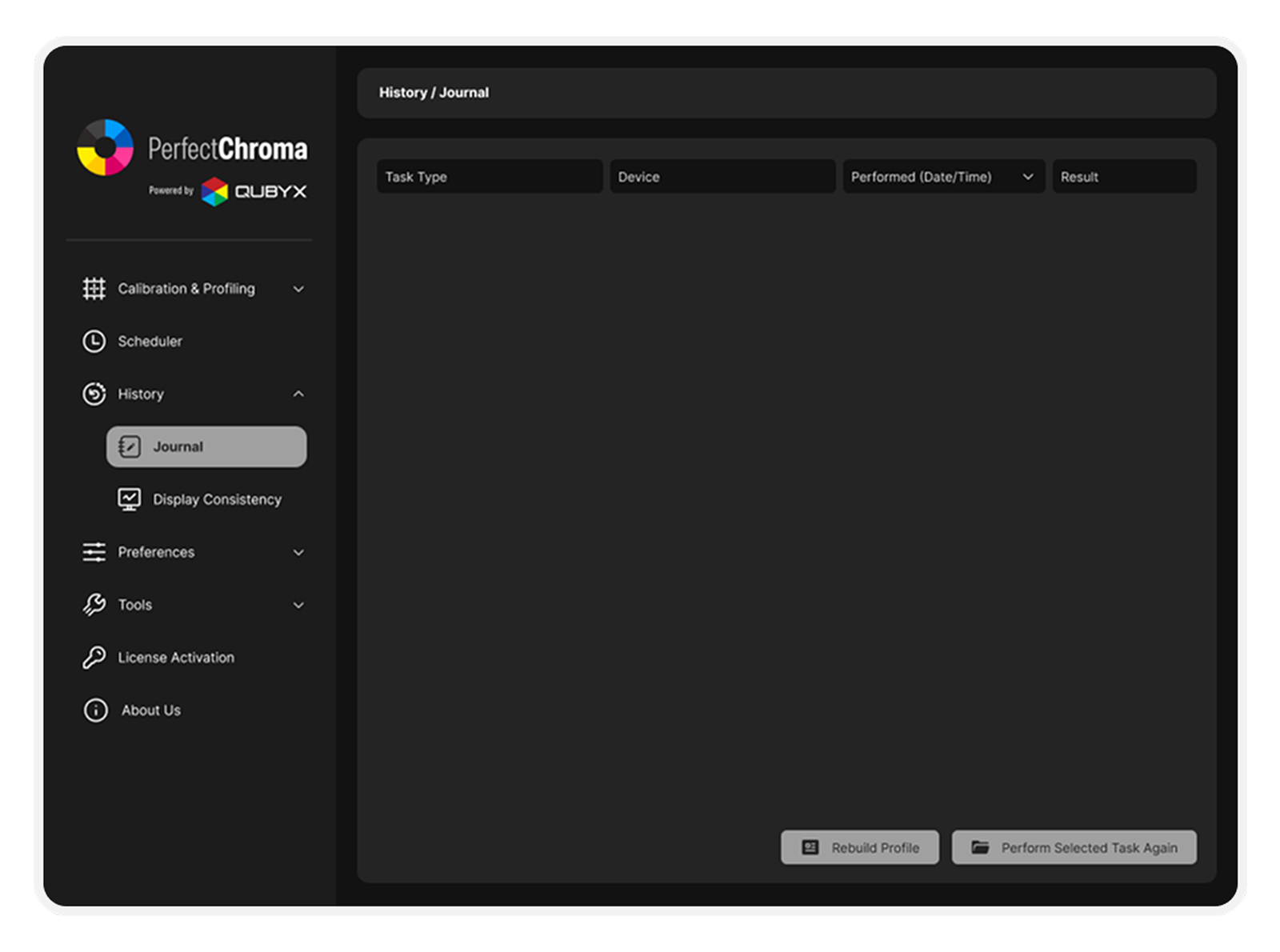
Generate monitor calibration verification documentation that satisfies every stakeholder - from Netflix QC supervisors to your own creative director.
Meet EBU R137, ITU-R BT.2111, and SMPTE RP 431 display certification requirements for OTT and broadcast deliverables.
Hand clients a branded PDF proving their deliverable was graded on a verified, specification-compliant reference display.
PerfectChroma compares current measurements against baseline verification data and alerts you the moment your display drifts outside tolerance.
Historical monitor calibration verification data shows the long-term degradation curve of your panel - helping you plan hardware upgrades before quality thresholds are breached.
Delta-E (Delta E) is the mathematical metric that quantifies the perceptual difference between a target color and a measured color. The most advanced formula for monitor calibration verification, Delta E2000 (CIEDE2000), accounts for the non-uniformity of human color perception by applying weighting functions for lightness (SL), chroma (SC), and hue (SH), as well as a rotation term (RT) that corrects for the problematic blue region of CIELAB space.
In practical terms: a monitor calibration verification Delta E2000 score of < 1.0 means the difference is imperceptible to trained observers; 1.0 - 2.0 is only noticeable by close side-by-side comparison; and > 3.0 is clearly visible. Professional broadcast standards (EBU R137, ITU-R BT.2111) typically require average Delta E2000 <= 1.0 and maximum Delta E2000 <= 3.0 for certified reference displays.
PerfectChroma's verification engine measures all 100 test patches in CIELAB coordinates (D50 adapted), computes Delta E2000 for each patch against the target ICC profile values, and generates statistical outputs including: mean Delta E, 95th percentile Delta E, maximum Delta E with patch identification, and a pass/fail verdict against your selected compliance standard. This gives you - and your clients - an irrefutable, quantified measure of your display's accuracy.
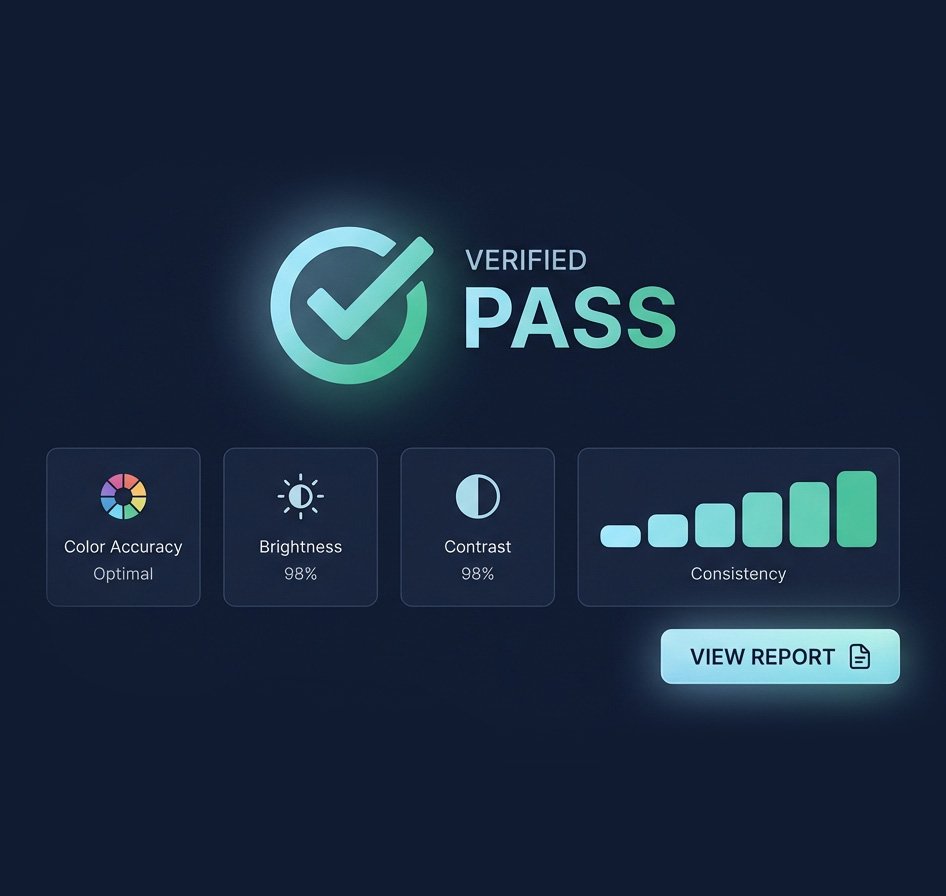
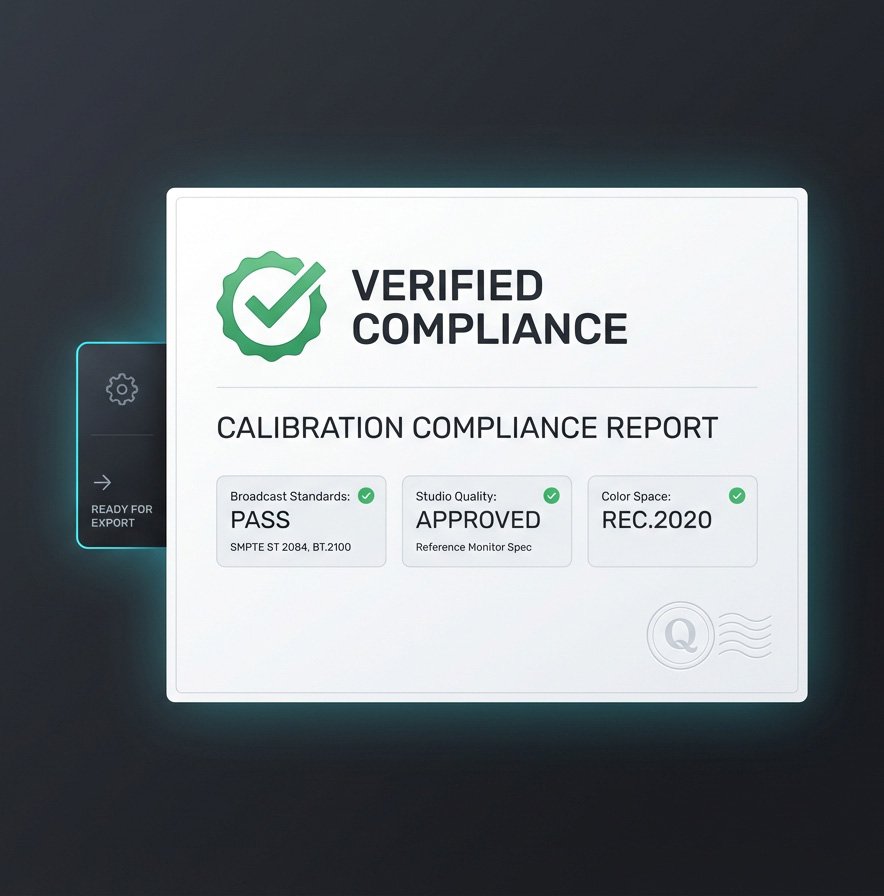
Major OTT platforms and broadcast networks have formalized their technical delivery specifications to include mandatory display calibration documentation. Netflix's Partner Help Center requires post-production facilities to maintain calibration records proving that reference monitors meet ITU-R BT.1886 EOTF tracking, D65 white point, and maximum Delta E <= 2.0. Disney+ and Amazon Studios enforce similar requirements under their respective Vendor QC guidelines.
PerfectChroma generates verification reports that map directly to these requirements. Each report includes: display make/model/serial, measurement sensor identification, calibration preset target specification, pre- and post-calibration Delta E data, gamma tracking charts with point-by-point deviation, white point chromaticity coordinates (CIE xy), and a timestamped digital attestation that the session was completed using validated measurement hardware.
For facilities pursuing ISF (Imaging Science Foundation) or THX Certified Studio status, PerfectChroma's historical verification database provides the longitudinal calibration history and compliance documentation required as part of the certification audit process. All data is exportable as PDF, CSV, or JSON for integration with facility management systems.
Learn how PerfectChroma's verification and documentation tools help you meet professional standards.
Generate compliance-grade monitor calibration verification documentation for every calibration session - and give clients, broadcasters, and studios the verified proof they demand.