A foundational guide to light, spectra, color temperature, and standard illuminants for anyone working with color-critical workflows.
Color management starts with light. Without a clear understanding of how light behaves, how it is measured, and how it influences observation, it becomes difficult to explain either color perception or color reproduction in a reliable way.
What is light?
Historically, light was first described through emission theories associated with Newton. Later, Thomas Young and Augustin Fresnel established the wave nature of light, and James Clerk Maxwell demonstrated that visible light is part of the electromagnetic spectrum. Heinrich Hertz later confirmed those principles experimentally.
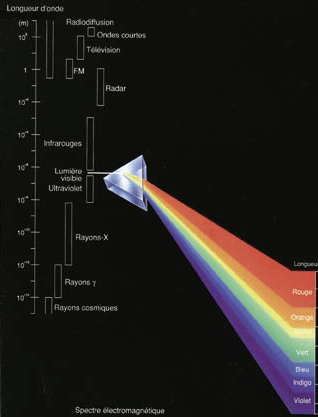
Light can therefore be understood as electromagnetic radiation. Different wavelengths correspond to different regions of the spectrum, and only a very small portion of that spectrum is visible to the human eye.
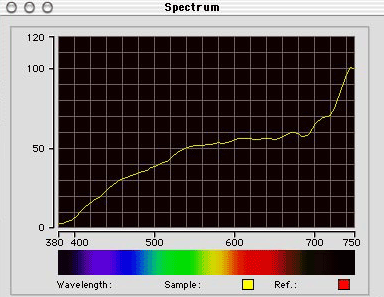
A spectrum is a graphical representation of the energy emitted at each wavelength. Sunlight is relatively balanced across the visible range, while artificial sources often emphasize particular regions of the spectrum. That is why different light sources change the way colors appear.
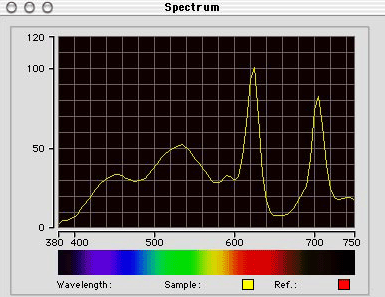
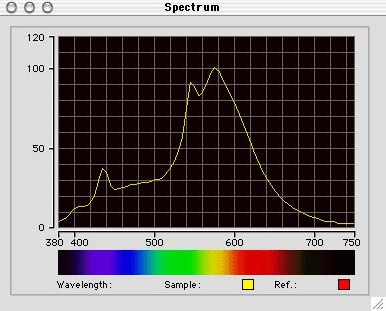
The different types of light sources
Electromagnetic waves are described by wavelength and frequency. In practical color work, the visible region is typically considered to span roughly 380 to 780 nanometers. What matters most is how the energy is distributed across that interval.
Continuous-spectrum sources
Continuous-spectrum sources emit energy across a broad and nearly uninterrupted range of wavelengths. Thermal sources are the most familiar examples. Their spectral output changes smoothly and is strongly related to temperature.
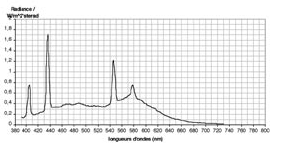
Discontinuous-spectrum sources
Discontinuous-spectrum sources emit at specific wavelengths rather than across a smooth band. Their spectra are built from distinct emission lines separated by gaps.
Mixed-spectrum sources
Many practical light sources combine both behaviors. A mixed spectrum contains a continuous base with distinct peaks or lines superimposed on it.
Line-spectrum sources
Line-spectrum sources emit strongly only at a few wavelengths. Lasers are the clearest example of this type of emission.
Black-body radiation and color temperature
The idea of color temperature comes from the behavior of heated matter. As an object absorbs energy and becomes hotter, the color of the light it emits shifts in a predictable direction. This relationship forms the basis for describing light sources in degrees Kelvin.
A black body is a theoretical reference that absorbs all incident radiation and re-emits energy according to temperature alone. Real light sources are compared to that ideal behavior. Lower color temperatures tend to appear warmer and more yellow-red, while higher values appear cooler and more bluish.
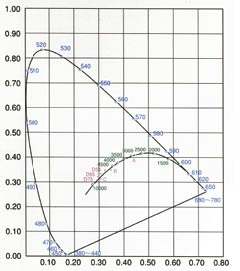
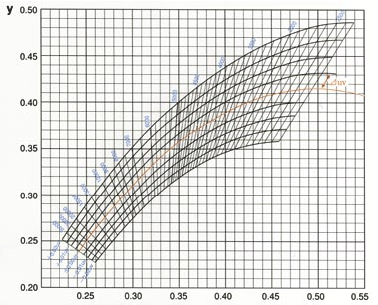
Typical examples help place this in context: a candle flame sits around 1400 K, a tungsten lamp around 2800 K, daylight around 5500 K, and an overcast sky can rise well above 6500 K.
The black-body locus
The black-body locus can be plotted in chromaticity diagrams such as CIE Yxy or CIELUV. By comparing a measured light source to this locus, it becomes possible to estimate correlated color temperature and evaluate how far the source deviates from an ideal radiator.
Standard illuminants
Colorimetry uses standardized illuminants so that measurements and evaluations can be reproduced consistently. The CIE defined a hierarchy of illuminants representing incandescent light, average daylight, and several fluorescent conditions.
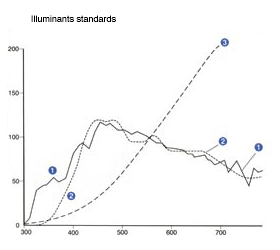
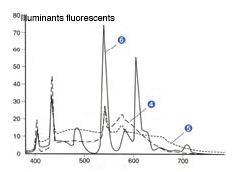
Among the most important reference illuminants are A for incandescent light, C for average daylight without ultraviolet content, D65 for average daylight including ultraviolet influence, and the F series for fluorescent sources.
Once the fundamentals of light, color temperature, and standard illuminants are understood, we can move to the next essential topic: how the human visual system interprets color.