A guide to the behavior of displays, scanners, printers, and production hardware across a color-managed imaging chain.
Displays
CRT monitors
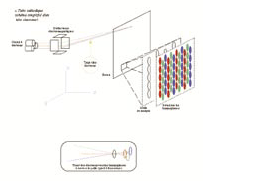
For many years, the CRT monitor was the reference display in graphic arts because it offered deep tonal range, broad viewing tolerance, and well-understood calibration behavior. A CRT works by firing three electron beams, one for red, green, and blue, onto phosphors on the inner surface of the tube. As the beam scans the screen line by line, those phosphors emit light and build the visible image.
This is an additive system: the image is formed from emitted light, and the final colour depends on how strongly the red, green, and blue phosphors are excited.
Mask and phosphor structure
Between the electron guns and the phosphor layer sits a mask or grille that directs the beams toward the correct colour elements. Traditional shadow-mask displays use round phosphor dots behind perforated metal. Aperture-grille systems such as Trinitron and Diamondtron use vertical slots and striped phosphors. These constructions affect contrast, sharpness, colour separation, and suitability for critical prepress work.
Phosphor quality also matters. Different phosphor formulations produce different chromatic behavior, contrast, and stability. In professional imaging, monitor choice was never only about screen size. It was about whether the display could be trusted for tonal and color judgment.
Refresh rate and dot pitch also influence comfort and quality. A low refresh rate can cause visible flicker and eye fatigue, while dot pitch affects perceived sharpness. In production environments, the display should be stable enough for long sessions of image evaluation.
LCD monitors
LCD displays belong to the flat-panel family. They are compact, power-efficient, and easier to integrate into modern workspaces, but early LCD technology had real limitations for colour-critical work. Viewing angle, tonal stability, and calibration behavior were all less predictable than on a well-configured CRT.
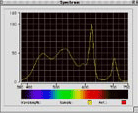
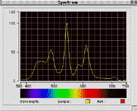
An LCD uses liquid crystals positioned between two glass layers and controlled by an electric field. Instead of emitting light directly like a CRT, the panel modulates a backlight and sends that light through RGB filters. Thin-film transistor technology, or TFT, made this approach practical for computer displays and eventually dominant in the market.


Strengths and limits of LCDs
Flat panels save space and reduce electromagnetic emissions, but early models were often difficult to use in a graphics workflow because their gamut was narrower, their viewing angle was more restrictive, and calibration tools were still immature. These limitations made precise image correction and on-screen approval more difficult than on a stable CRT.
Later LCD generations improved dramatically, but from the perspective of this training material, the important lesson is that display technology has a direct impact on profiling quality and on the confidence an operator can place in the screen.
Plasma displays
Plasma displays are emissive screens, meaning each pixel produces its own light. They rely on electrically excited gas cells rather than on modulated backlighting. Although they share the light-emitting nature of CRT displays, they were not the standard choice for graphic-arts production and remained more relevant to large-format viewing than to calibrated workstation use.
Ergonomics, standards, and viewing conditions
Display quality cannot be separated from working conditions. Safety and ergonomics recommendations, including those from TCO, TUV, Energy Star, and ISO 9241, were created to improve health, comfort, and functional screen use. In professional imaging, however, environmental control goes beyond ergonomics alone.
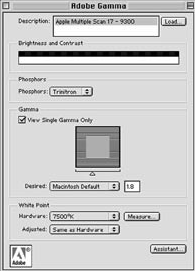
The room should be lit consistently, ideally with neutral ambient light around 5000K. Strong reflections, high contrast between screen and room, or poor monitor placement can undermine even a well-profiled display. The screen should not face a window, the surrounding environment should be visually neutral, and the operator should use a hood or other shielding when necessary.
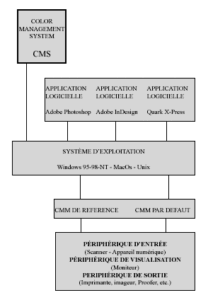
Temperature, lighting, monitor orientation, and viewing distance all influence practical image evaluation. Good color management starts with a good viewing environment.
Scanners
CCD sensors
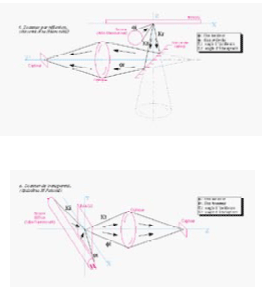
The scanner transforms light reflected or transmitted by an original into digital values. A CCD sensor performs several tasks at once: it converts light into electrical energy, accumulates that signal, and passes it along the chain for digitization. Because the signal begins as an analog response to light, both sensor quality and electronics quality matter from the very first stage of capture.
CCD sensors are semiconductors whose electrical behavior is shaped to react efficiently to incoming photons. Their performance is influenced by spectral sensitivity, thermal behavior, and the quality of the system surrounding them.
Signal accumulation and A/D conversion
Once light has been converted into an electrical signal, that signal must be accumulated and then converted from analog form into digital values. This is the role of the analog-to-digital converter. Sampling divides the image into discrete picture elements, and quantization assigns numeric values to those samples according to a chosen bit depth.
Bit depth matters because it determines how finely tonal information can be encoded. A 48-bit colour scanner, for example, records far more tonal precision than an 8-bit-per-channel device. That greater precision gives later stages of the workflow more room for correction, profiling, and stable conversion.
Flatbed scanners
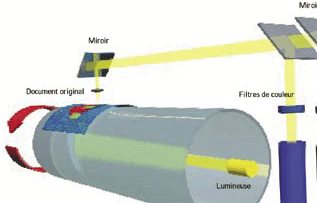
In a flatbed scanner, a light source illuminates the original, mirrors and lenses direct that light toward the sensor array, and the captured signal is converted into digital data. The quality of the light source, optics, filters, sensor, electronics, and software all influence the result. A scanner is therefore not just a capture device. It is a complete interpretation system.
Flatbeds became widely available because they were relatively affordable, easy to use, and good enough for many professional tasks. Even so, high-end work historically favored drum scanners because they could reach greater density range and finer tonal interpretation.
Drum scanners use photomultipliers, or PMTs, instead of CCD arrays. A photomultiplier captures incoming light and amplifies the resulting electron flow through secondary emission. This produces a very sensitive detection system that can read deep densities and subtle tonal transitions with exceptional precision.
That sensitivity is one reason drum scanners remained the premium choice for demanding reproduction work. Their downside is cost, complexity, and slower handling compared with flatbed systems.
Printers and output systems
Output devices vary widely, but they all face the same challenge: translating digital data into a physical image while staying as close as possible to the intended colour appearance. The technology used by the printer strongly influences gamut, smoothness, screening behavior, and profile strategy.
Inkjet printing
Inkjet systems form the image by projecting microscopic droplets onto paper or another substrate. Two major technologies dominate the category. Piezoelectric systems use electrically controlled crystals to eject droplets, while thermal inkjet systems use heat to generate a pressure pulse inside the print head.
Droplet size, head design, ink chemistry, and media behavior all contribute to the final result. This is why inkjet devices range from office printers to high-end proofing systems. The same fundamental principle serves very different production goals depending on how precisely it is implemented.
Xerography
Xerography is an electrophotographic process based on electrostatic attraction. A photoconductive surface receives an image, electrically charged toner is attracted to the appropriate areas, and the toner is then transferred and fused onto paper. This process became the foundation of many digital copiers and laser-printing systems.
Because it is dry and highly automated, xerography proved especially useful for productive short-run environments and laid much of the technical groundwork for digital printing.
Continuous-tone systems
Thermal sublimation
Thermal sublimation uses heat to transfer dye from a donor ribbon into the receiving medium. The amount of dye transferred depends on temperature, allowing smooth tonal modulation that can look very photographic. Because the colourant diffuses into the medium rather than forming a typical halftone dot structure, sublimation was often valued for proofing and presentation output.
The process depends on careful coordination between ribbon, paper, transport system, and heating elements. Its quality can be very high, but it is tied closely to the specific materials designed for the device.
Silver-halide printers
Silver-halide digital printers expose photographic paper with controlled light sources, often lasers. The paper then goes through a photographic development process. These systems bridge digital input with traditional photo chemistry, producing highly smooth and continuous-looking colour output.
Imagesetters and film output
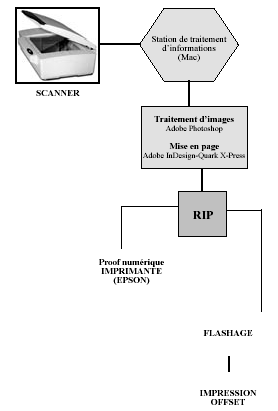
Imagers expose photosensitive film or paper directly from digital files. Depending on the system, exposure may come from a CRT source or from lasers. For many years, this stage sat between page preparation and final plate making, providing the films required for conventional offset production.
Digital printing
Digital printing can be understood as a production process in which digital files move directly into a printing engine without the full sequence of traditional prepress steps. Its major strengths are flexibility, short-run efficiency, personalization, and speed. Unlike conventional offset, it excels in print-on-demand contexts where job size is small but variation is high.
Several technological families exist within digital printing, including dry-toner electrophotography, liquid-toner systems, and inkjet-driven presses. In every case, the workflow depends on a front-end server or DFE, often paired with a RIP, to translate production files into device-ready output.
CTP: Computer to Plate
Computer-to-plate technology eliminates the film stage and images plates directly from digital data. The RIP produces a bitmap, lasers expose the plate line by line, and the resulting plate moves directly into the offset process. This shortens production, improves registration, and can provide more predictable dot behavior than film-based plate making.
CTP became a major development in prepress because it simplified the workflow while increasing precision. It also reinforced the need for reliable digital files, reliable screening, and reliable color management upstream.
Digital presses
Digital presses further reduce the traditional chain by removing or minimizing film creation, manual plate handling, and other prepress stages. Some digital press systems still rely on replaceable imaging forms, while others use technologies in which no permanent printing form exists at all. Their shared strength is agility: fast turnaround, variable data, and efficient short runs.
These systems do not replace offset in every scenario, but they complement it extremely well. For personalized or low-volume work, they often provide the most practical production model.
Hexachrome and extended-gamut printing
Traditional process printing relies on four colours: cyan, magenta, yellow, and black. Extended-gamut systems add colours such as orange and green to increase the reproducible range. In theory, this can reduce the need for some spot colours and allow more vivid or difficult hues to be reproduced within a process framework.
In practice, six-colour workflows are more complex to separate, proof, and control. Their economic cost is higher, and they require very careful management of screening, profiles, and press behavior. For that reason, extended-gamut printing historically remained more specialized than mainstream four-colour production.
Halftoning, or dithering in a broader digital sense, is the technique that makes continuous-tone images printable with inks or toners of fixed density. Instead of varying the thickness of the colourant, the system varies dot size, spacing, or frequency so that the eye perceives lighter and darker tones.
Traditional screening uses regularly arranged dots, while stochastic or frequency-modulated screening uses dots of more uniform size with variable spacing. One of the classic risks in regular screening is moiré, an unwanted interference pattern caused by interactions between screens or between a screen and image structure. Randomized screening strategies help reduce that problem.
Offset is a planographic printing method based on the repulsion between water and greasy ink. The plate carries image and non-image areas with different surface behavior. Ink adheres to the image areas, the image transfers first to a blanket cylinder, and from there onto the paper. This indirect transfer is one of the reasons offset can produce high quality at industrial speed.
Because it supports a wide range of formats, papers, and print qualities, offset remained the dominant benchmark for commercial printing and for many proofing and color-management targets.
Film output, historically called imagesetting or film flashing, sits between creative preparation and press production. The goal is to expose a photosensitive film from digital page data, usually through a RIP-driven system, so that the resulting separations can be used for proofing, plate making, and press preparation.
This stage was central to traditional workflows because it linked digital layout and image editing to the physical printing process. Even when later technologies reduced its role, understanding film output remains useful for understanding the structure of classic prepress.