A practical guide to human color vision, perception, and the observer-light-object relationship behind reliable color decisions.
Defining color
Color is never produced by an object alone. It emerges from the relationship between a light source, the physical properties of the object being viewed, and the observer interpreting the result. Any practical discussion of color management has to begin with this three-part relationship.
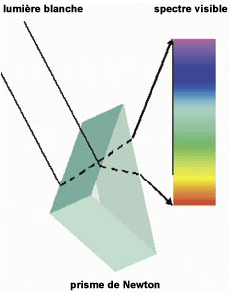
Newton demonstrated that white light can be dispersed by a prism into the visible spectrum. In practical terms, that spectrum extends roughly from 380 to 780 nanometers, and each region of it contributes differently to human perception.
The observer-object-light-source triad
Color can be understood through three inseparable components: the observer, the object, and the light source. Change any one of them, and the perceived color may change as well.
The observer
The eye does not perceive all wavelengths with the same efficiency, and the brain is responsible for turning retinal signals into visual experience. This is why color science relies on the idea of a standard observer rather than on purely subjective judgment.
The object
The object is the second element of the triad. Its surface, chemistry, and structure determine how incident light is reflected, absorbed, scattered, or transmitted. Those interactions largely explain why the same object can appear different under changing illumination.
The light source
The light source is the third essential element. Since every source has its own spectral distribution, it directly influences the way the object is seen. Color cannot be discussed accurately without specifying the illumination condition.
The eye as an optical system
The eye functions in many ways like a camera. The iris and pupil regulate incoming light, the transparent media focus it, and the retina acts as the photosensitive layer. Once the retina is stimulated, the optic nerve carries the signal to the brain, where visual sensation is formed.
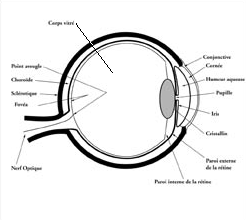
The retina contains two main receptor families: rods and cones. These are responsible for different aspects of vision and are fundamental to color perception.
Cones and rods
Rods dominate low-light vision. They are highly sensitive, especially around the green-cyan region, but they do not provide detailed color discrimination.
Cones are responsible for daylight vision, fine detail, and color. Human color vision depends on three cone families with sensitivities that roughly correspond to red, green, and blue response regions. Their combined activity makes trichromatic perception possible.
Color-vision deficiencies
When one receptor family is absent or impaired, color discrimination changes significantly. Common forms of deficiency include protanopia, deuteranopia, and tritanopia, corresponding to reduced or missing red, green, or blue sensitivity.
Additive and subtractive color synthesis
Additive synthesis creates color by combining red, green, and blue light. It is the operating principle behind monitors, scanners, and video displays.


Subtractive synthesis works in the opposite direction. Instead of adding light, it removes portions of white light through cyan, magenta, and yellow colorants. This is the basis of print reproduction.
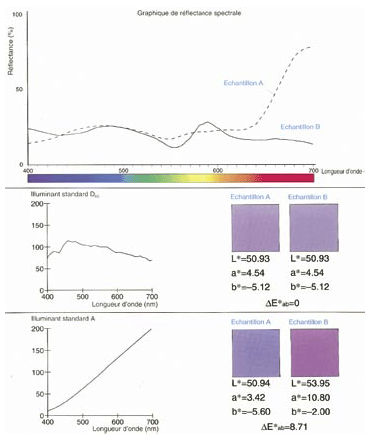
Metamerism
Two samples may appear identical under one illuminant but diverge under another. This effect is called metamerism, and it is one of the key reasons color evaluation must be tied to controlled viewing conditions.
Human vision and imaging systems
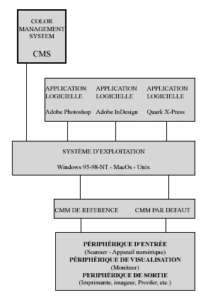
Digital imaging systems encode color numerically, but they do not perceive or reproduce color exactly like the human visual system. Every capture, display, and output device imposes its own limits. The purpose of color management is to reduce those differences and keep reproduction as consistent as possible across the full workflow.
Viewing conditions
Because illumination has a direct influence on perceived color, viewing conditions must be controlled. Standards such as ISO 3664 define practical guidance for critical evaluation. In production environments this generally means neutral surroundings, controlled ambient light, minimized reflections, and standardized viewing illumination such as D50.